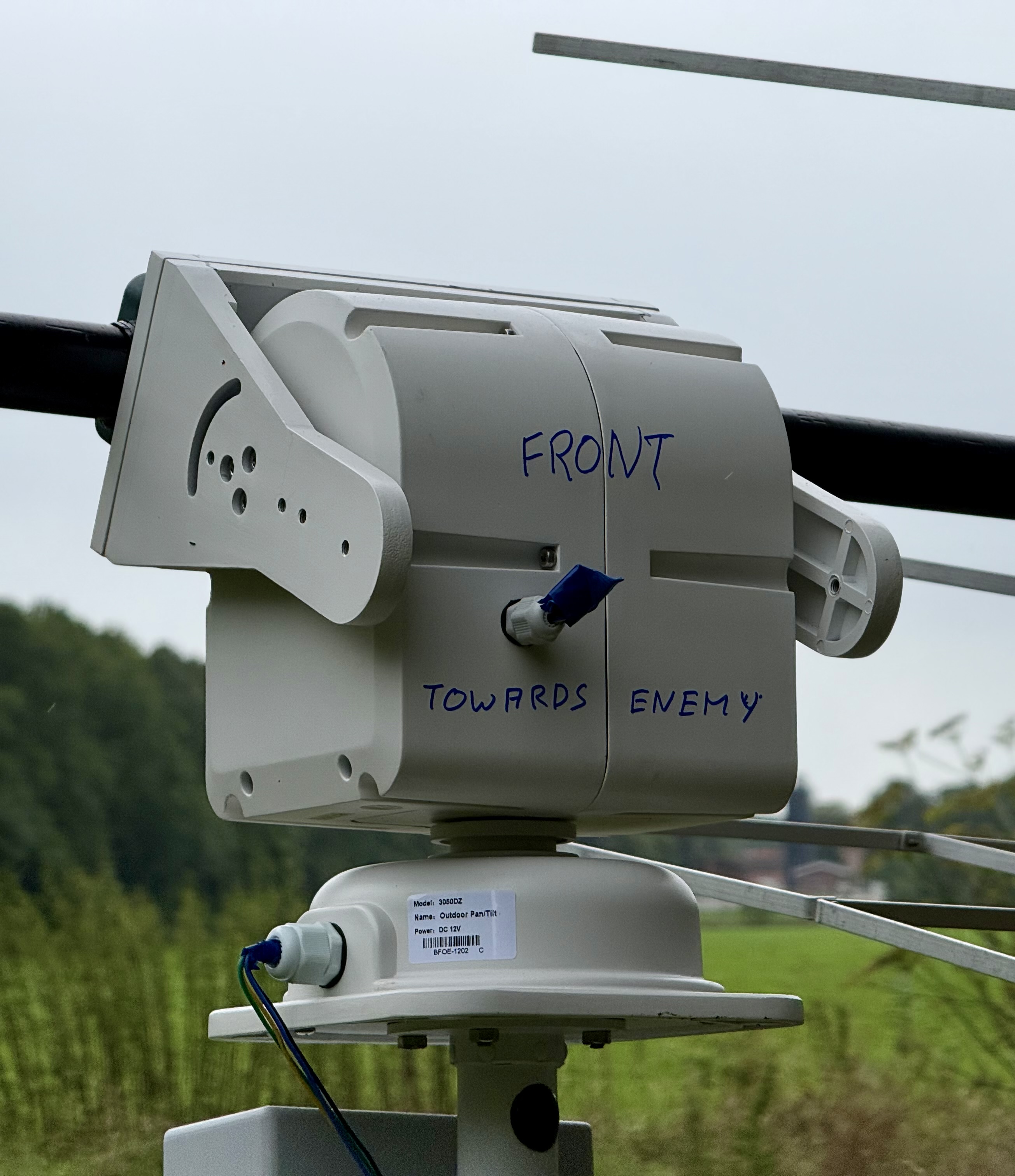
Chinese PTZ gimbal as light portable AZ/EL rotator
I was looking for a cheap way to play with LEO amateur sats. Elevation rotators were too expensive, so I looked at other alternatives.
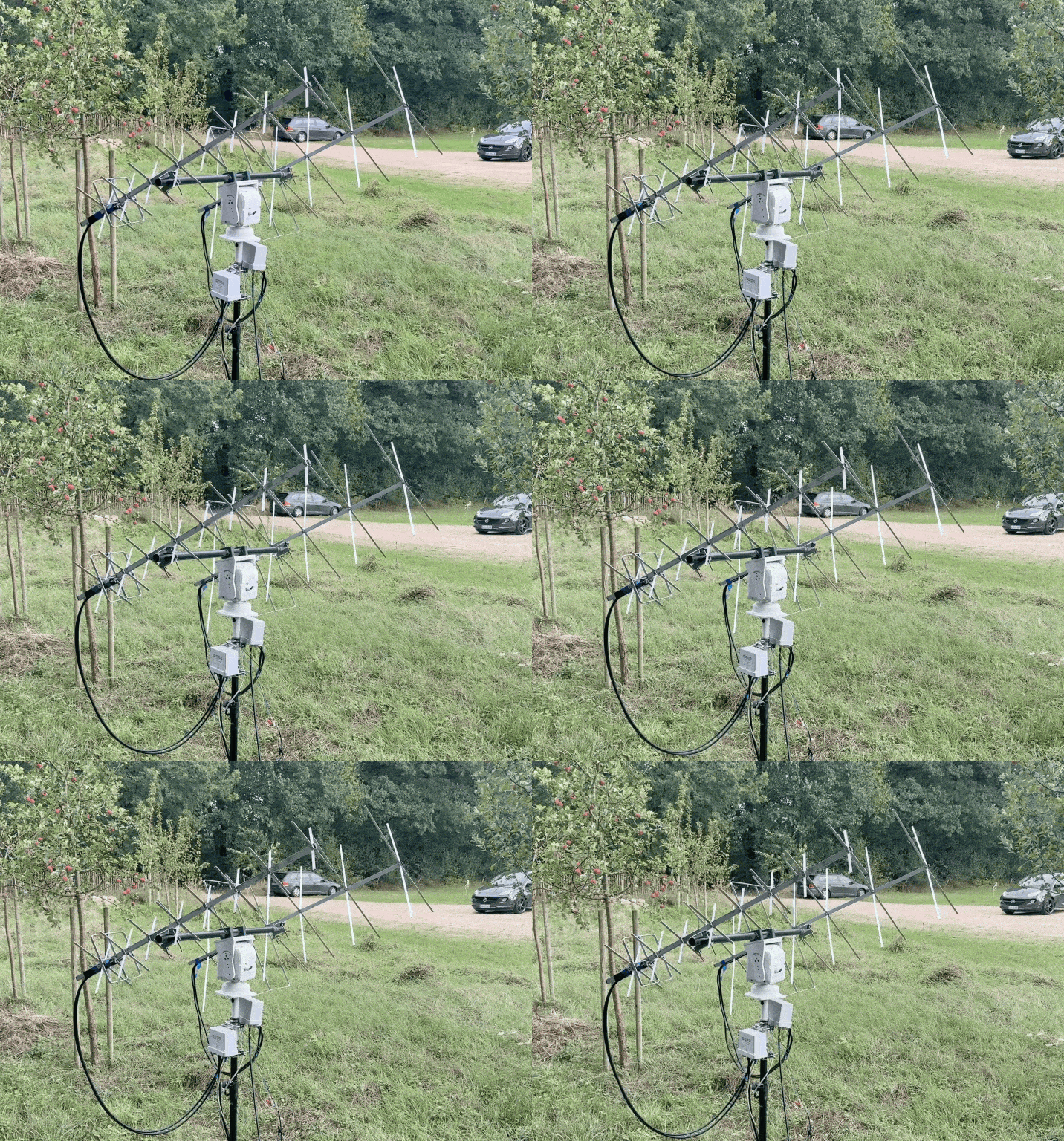
(Tracking SONATE-2 -- wobbling is mostly because of the soft base; however RF does not care.)
I came across the ANTRUNNER (which is not weatherproof) and the ANTRUNNER Pro (which is weatherproof) and also realised that this very much looks like certain Chinese PTZ camera gimbals. Because of the relatively low cost (less than €300 all in), I took the plunge and bought one ("mausgerutscht") hoping that I can make it do what the ANTRUNNER Pro does without the ~700€ price tag at the time. (Now the price on Tindie has come down quite a bit)
The device itself is a quite sturdy metal construction, with metal gears. I got the "3050DZ". By my request a version without end-stop and 360 instead of 350 azimuth motion range -- it can rotate without limits. There is a version with azimuth limits and also another one called 303 or 3055.
Pay attention to the motion range. Most camera gimbals have a too small elevation range.
Hardware-wise, the azimuth axis has a "0 degree" sensor and elevation has limit switches. Supply voltage is 12V (or my shack 13,8 seems fine).
Control is via RS484. You need 4 wires to control it.
It has some peculiarities when controlling:
1. To have a correct elevation reading, the device needs to perform a calibration self-test every time after a power loss. This self-test will turn the gimbal clockwise until it has seen the 0 degree sensor twice. So between 360 and 719 degrees.
When calibrated, you have a working goto azimuth / elevation as well as current position read-back.
2. Without calibration, you don't have any useful elevation reading. I tried for a long time. There are other open-source projects that gave up on this and simply perform slow "jog for time x", aka dead reckoning.
3. You can not realiably interact with the device while it's moving, the interface is labelled half-duplex.
I created a simple bridge that presents itself as a "rotctl" network server.
This bridge is here (https://github.com/kgbvax/StationA/tree/main/pelcobridge2), It's part of some other bigger hamslop experiment which is under constant change so buyer beware. ;-)
My strategy eventually ended up like this:
- Have the "power on self-test calibration disabled" to avoid unwanted movement on power-up / power-cycle.
- Have my driver to ignore all commands until it has been manually armed
- Arming involves me checking whether the cables are right. I manually move it 370 degrees counterclockwise so that - after calibration - the cables are perfectly untied.
- After arming, it can be controlled if rotctl-aware apps.
- I tried with adaptive slow jogs & readbacks (to reduce vibration) and simple go-to commands. Both work. The problem is that you want quick movement when you have to do a flip-over (180-degree azimuth change).
So that works and I think it is fine for portable or occasional use.
Bauwagen Plan
Since I currently plan to replace my 2x2 VHF stack with something more flexible, I will move to an old Kenpro 500 up on the VHF mast instead of this setup. This allows me to add more things (23cm) and also allows a simpler flip-over for overhead passes.
The goal with the new setup is:
- Have vertical polarised capability (talk FM to buddies and repeaters) - I need the maximum height since my location is not great for that purpose.
- Have horizontal polarised capability and some gain to
- Allow me to play with some mid-range sideband,cw,Westfalen etc.
- Maybe work some aircraft scatter (not sure if antennas have enough gain for that)
- Have 70cm capability
- Have LEO SAT capability
I may keep the gimbal for portable use (although I don't know any portable cases other than demonstrations) -- if you are keen to own it talk to me I might sell it to you.